





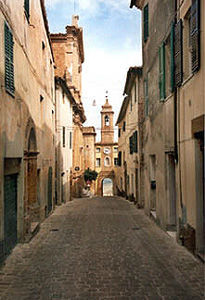
Walking along Corso Tarcisio Tassi, a longitudinal narrow road that goes from gate to gate surrounded by narrower streets, you will arrive at the Medieval Castle, the heart of the village.
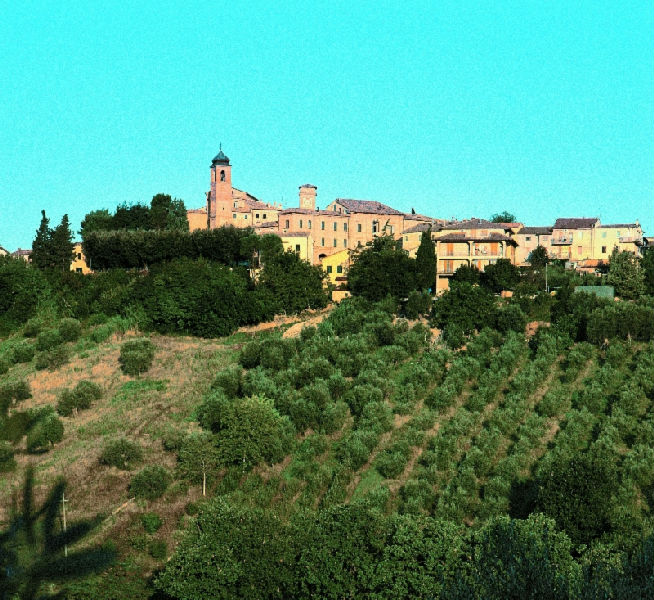
It’s hard to imagine a better setting in which to enjoy wonderful walks along its beautiful landscapes and the flavours of traditional recipes.
Small castle situated atop a hill rich in vineyards and still strongly tied to the production of Verdicchio wine.
San Paolo of Jesi dominates the right side of Esino Valley, just 12 kilometers from the town of Jesi.
The population is composed of just 930 inhabitants and the village extends 10 square kilometers.
It can be easily reached from the major towns of the valley and of the Adriatic coast. It is 40 kilometers far from Ancona, 25 km from Falconara airport and only 5 km from the highway.
San Paolo derives its name from St. Paul who has been its patron since the Middle Ages .
The original name was "Castrum Montis Sancti Pauli" and referred to a small church dedicated to St. Paul, which may have belonged to the monks.
On 8th February 1863 the specification “of Jesi” has been added to the traditional name in order to distinguish it from other towns having the same name.
Only in 1079 there is the first evidence of primitive "castrum" while the first mention of San Paolo as a castle of the County of Jesi dates back to 1275.
San Paolo was mentioned together with Staffolo on occasion of an adjustment of the borders between the towns of Jesi and Osimo in 1286 and therefore it belonged surely to the County of Jesi. This was later confirmed both in the "Descriptio Marchiae Anconitanae", a collection of contemporary documents, in which San Paolo is one of the "castrates and villas" of the town of Jesi, and in Egidiane Constitutions issued in 1357 by cardinal Albornoz after the recovery of the various communities in the Marches which had rebelled against the Church of Rome.
During the first half of the fifteenth century Jesi was incorporated in the State of the Church and as a consequence San Paolo too recognized the sovereignty of the Pope. The castle of San Paolo belonged to the County of Jesi until 1808. After the descent of Napoleon's troops it became part of the canton of Apiro and later it was annexed to the municipality of Monte Roberto until 1818 when Pope Pius VII gave it independence. However in 1928 the fascist government decided to unite it to Staffolo. Only in 1946 San Paolo gained its autonomy again.
Climb the hill for a look around some remains of the walls of the church Santa Maria d’Arco and the attached Augustian monastery and admire the beautiful decorated in silver and copper gilt chalice, bearing the date 1523 and the name of the church it belonged to.
Cupramontana, S. Marco, Calapina, Castelbellino, Monteroberto, Maiolati Spontini, Cupramontana
Distance: km 14
Time advised: 75 minutes
Difficulty: easy
Starting from the parking in front of Colonnara winery, take the road for the historic centre.
Just before arriving at Cupramontana, follow the signs indicating the cemetery . In front of the cemetery, take the avenue on the left . Go through San Marco street and turn left until reaching a junction , then turn right and take the white road. The path becomes flat only for a short distance, then it is narrow again and turns on a slight slope. Turn left and right; at the bottom of a steep slope cross the farmland and then right up to a bar. From here proceed along an old house until reaching a white road.
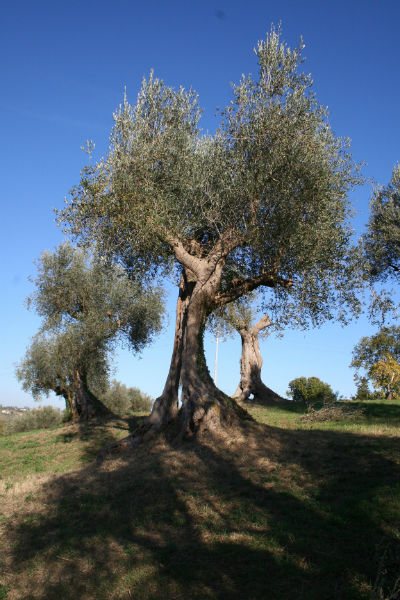
Follow the steep path to the right (Calapina Street), after about 100 metres turn left and follow the main road for about 500 metres until the junction with the big oak tree. Go straight on for about 100 metres and turn left uphill just before the descent. At the junction take the flat road on the right passing through a fence and a wash-tub and climb up to a big villa with a park; straight down until reaching the tarmac road (S.P. Castelli di Jesi).
Follow the left road that leads to Castelbellino. When you join the village, just before the last houses, turn right uphill to Monteroberto (approx. 800 metres). Then right under the castle walls and go straight up to the Provincial Road (S.P.).
At the junction turn to the right arriving at Maiolati Spontini. Go through the village and take the white road on the left. Continue until you come back to the Provincial Road and follow the signs indicating Cupramontana. After about 1,5 km you are again at the point of departure.







Castelli del Verdicchio - cookie policy - credits
Tel. +39 0731778710
Fax. +39 0731778750
Via Nazario Sauro, 1
60034 Cupramontana (AN)









 |